Monday, 19 September 2016

Archaeologists uncover new monument on Bodmin Moor

Archaeologists uncover new monument on Bodmin Moor

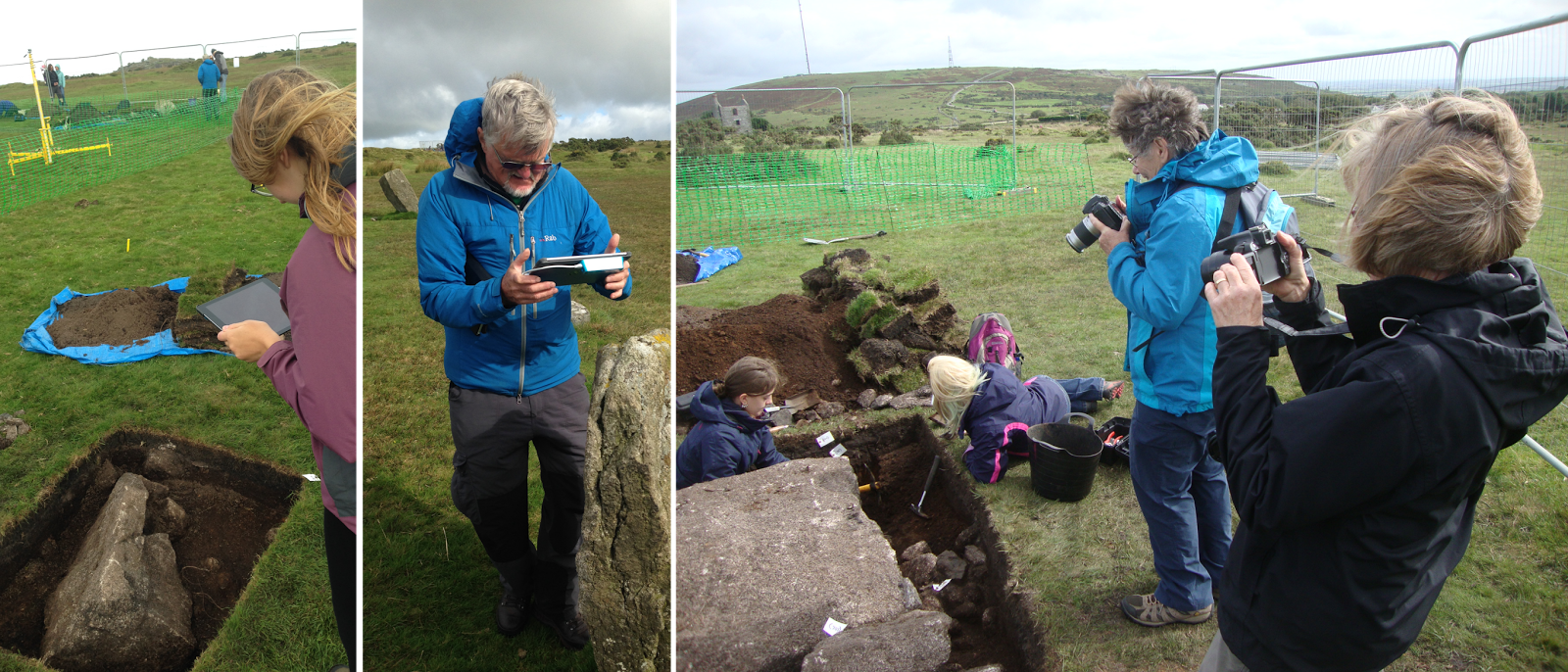
Archaeologists have been excavating a new site close to The Hurlers stone circles on Bodmin Moor over the last week.  The excavation, which took place between 13th and 18th September was part of the Reading the Hurlers project largely funded by the Heritage Lottery Fund with support from the Cornwall Heritage Trust.  Around fifty volunteers along with Cornwall Archaeological Society, the local community, Truro College and universities including UCL were involved in the dig, as well as amateur geologists from Caradon Amateur Geology Group and Saltash U3A geology group.


The aim of the excavation was to identify whether a group of stones in a circular formation formed part of a ‘fourth’ stone circle, close to The Hurlers.  Whilst this was found not to be the case, the discovery of a stone-lined socket hole at the base of large recumbent stone has led the project archaeologists to believe that the area was once the site of a large standing stone, possibly at the head of a processional avenue leading to The Hurlers themselves.  The same trench also revealed the tip of a late-Neolithic flint arrow head.  The flint tool, probably knapped from a locally sourced beach pebble, was broken soon after use and showed little sign of wear.  Archaeologist and project co-ordinator Emma Stockley said “this is a fantastic outcome for the project.  We have discovered the existence of a new standing stone that would have been an important part of the landscape around The Hurlers.  The volunteers have worked incredibly hard and we couldn’t have done this without them”.  Preliminary geological studies on a number of the larger excavated stones, some over two metres in length, are intriguing and suggest that the granite has not come from the immediate area.  Geological project co-ordinator Calum Beeson elaborates ""we've had volunteers carrying out geological surveys on the newly excavated stones and have found that one of the larger stones did not come from the immediate area and does not appear to have travelled there through natural processes.  This suggests that it was carried to its current location by human activities"".  Further studies will continue to shed more light on this ancient site.


The site’s open day attracted hundreds of visitors including history groups, dowsers, tourists and local families.  Guided walks led by Iain Rowe attracted over 70 people and a popular all-day astro-archaeology workshop was led by Brain Sheen and volunteers from the Roseland Observatory. Experts from CAU were on hand all day talking to members of the public and showing them around the dig site. 


The excavation received numerous visitors over the week and schools were invited, giving over 80 local pupils the opportunity to view the excavation in progress, question the archaeologists and voice their own theories for the presence of The Hurlers.  Pupils were shown Bronze Age flint tools and a replica bronze axe head and learnt more about how people lived on Bodmin Moor 4000 years ago. 


The trenches were backfilled on Sunday and the excavation site will continue to be fenced for a further few weeks to enable the turf to re-stablish.


The project findings and report will be available over the next few months, here on the project website www.readingthehurlers.co.uk and the project team will be giving a series of talks locally in the new year.


Saturday, 17 September 2016

Reading The Hurlers – Dig Week – Day 6 Open Day


Reading The Hurlers – Dig Week – Day 6 Open Day

An action packed day on Bodmin moor at the Dig Site, with hundreds of visitors taking a look in the trenches to see the results of the week long archaeological dig, and join in the many activities through the day.


Experts were on hand all day answering questions and discussing theories of Archaeology and Geology, while many of the trenches were being dug and recorded by the hard working team of diggers. Archaeologists from Cornwall Archaeology Unit continued to map, measure and record whilst also talking visitors through the dig site trenches.


Emma: "A huge thank you to all those who took part in both the Dig and the Open Day, it would not have been the successful event it was without everybody’s efforts."


Throughout the day Brian Sheen and his team from the Roseland Observatory held drop-in workshops which explored the astro-archaeology of The Hurlers and surrounding area. They explained some of the theories of the stone alignments in The Hurlers complex, in addition to casting their expert eye over the freshly exposed megaliths at the dig site.


Iain Rowe guided a small army of keen walkers across the moors on the Beyond the Horizon guided walk, taking in key monuments which cannot be seen direct from The Hurlers, but are part of the wider historical landscape.


Towards the end of the day, and with a huge amount of excitement a Socket Hole was discovered at the base of the large stone lying in Trench F. This stones geological make up already informed us that it had been brought to the area  (as have several of the large stones in the dig area) and a Neolithic arrow head was discovered beneath the side of the stone in Trench F. With the socket hole located we might surmise this stone was indeed a standing stone megalith, and alignments have been suggested to Solstice sun positions.  


Did we uncover a fourth circle or are the stones part of a more complicated monument? It is still early days to fully understand and the evidence collection is ongoing, the area is a complicated historic landscape and we continue to read the hurlers for more information.


James: We’ve had a brilliant week on RTH and we’d like to thank all the volunteers for all their hard work and dedication. Following painstaking cleaning and excavation around the stones we are confident that at least one of them was once a standing stone. This stone, Trench F, is where the arrowhead was found.


Reading The Hurlers - Digger Teams debrief at the end of the dig week. - Spherical Image - RICOH THETA

Friday, 16 September 2016

Reading The Hurlers - Dig Week - Day 5 - Part 2

Reading The Hurlers - Dig Week - Day 5 - Part 2

Members of the U3A formed a team under tuition from Reading The Hurlers media head Matt Clark, to scan and 3d-map the Hurlers standing stones and the stones recently exposed in the dig. This was done through a range of techniques, from detailed photogeometry / photogrametry (terms for software that captures real-world data as 3d models - surface texture, colour and shape) techniques to laser depth scanning. Many of the megaliths and trenches, large and small, were digitally captured, allowing further off-site study. Here is a selection of the captured 3D models.


Reading The Hurlers - Dig Week - Day 5

Reading The Hurlers - Dig Week - Day 5

Our final Full day of digging today on Bodmin Moor, but the action will continue tomorrow as part of the Saturday Open Day!


The site was a frenzy of activity, with much encouragement from the Neolithic find yesterday. Many of the trenches were cleared and photographed, whilst more complicated trenches are still being examined and excavated, with the soils of each sieved and checked.


At the Hurlers Stone circles and in the wide moorland landscape, geologists continued the ongoing fieldwork to identify, measure and record the geological make-up of standing stones which form the circle, and the moorland stones. The surveying fieldwork has been ongoing every week from April, producing a detailed database. Head geologist Calum Beeson collates all the survey information in order to produce the knowledge base, which is now being used to match probable quarrying source sites to the individual standing stones.


From trench observations and field analysis, it appears that several of the major stones, and smaller surrounding rocks, have been brought to the site from further afield. The largest stone, in Trench A would have been a huge undertaking to move, and yet all indications from the geological make-up are, at present, that the stone has been moved to the area from elsewhere.


Members of the U3A formed a team under tuition from Reading The Hurlers media head Matt Clark, to scan and 3d-map the Hurlers standing stones and the stones recently exposed in the dig. This was done through a range of techniques, from detailed photogeometry / photogrametry (terms for software that captures real-world data as 3d models - surface texture, colour and shape) techniques to laser depth scanning. Many of the megaliths and trenches, large and small, were digitally captured, allowing further off-site study. The data is being collated and the 3D models will be posted soon!

Further groups from the U3A also joined us on the moors photographing many of the megalithic sites and the new dig site trenches.


Emma: “We are all really excited about the Open Day tomorrow and are busy preparing the trenches for the public viewing and the ongoing recording.
Some of the student volunteers are getting to grips with the archaeological recording techniques, under the tuition of James Gossip.”


The Dig trenches will be finalised, recorded, plotted, sketched, mapped and measured. Geologists study the exposed rock from each trench, ready for eventual back filling once all is analysed.


As the day drew to a close, and in preparation of the Open Day, we gathered as one large group to tour each trench and share our thoughts about the site, and discuss the evidence and ideas being deduced by the archaeologists and geologists.

There is still lots to learn about the Hurlers.

Thursday, 15 September 2016

Reading The Hurlers - Dig Week - Day 4

Reading The Hurlers - Dig Week - Day 4

Another fantastic day at the archaeology dig at The Hurlers on Bodmin Moor. Our excellent teams of diggers arrived bright and early on site once more to continue the  investigation of the possible 4th circle area. With both Archaeologists and Geologists studying the stones appearing form each trench an interesting picture is loosely forming.


Our most exciting news today is the discovery which appears to be the tip of a late Neolithic flint arrow head, very freshly napped before being left in the soil. Further study will no doubt reveal more.


Jackie – “It is looking like the three largest stones do not belong on this landscape. They are likely to have been dragged or brought to the site, perhaps from a radius of ¼ to ½ a mile away.”


To help you get into the trenches with our diggers, here is a selection of 360 views from inside area of the dig site. The trenches are at various stages of investigation, having been started at different times

Reading The Hurlers - Stone Circle archaeology dig - Spherical Image - RICOH THETA

Reading The Hurlers - Stone Circle archaeology dig - Spherical Image - RICOH THETA

Reading The Hurlers - Stone Circle archaeology dig - Spherical Image - RICOH THETA

Reading The Hurlers - Stone Circle archaeology dig - Spherical Image - RICOH THETA


On Day 3 we were also visited by the Plymouth and District Archaeological Society, who toured the site and surrounding area with members from the Reading The Hurlers team.


Wednesday, 14 September 2016

Reading The Hurlers - Dig Week - Day 3

Reading The Hurlers - Dig Week - Day 3

Another busy day on site, the second full day of digging and this time with full sunshine. We have opened up another small trench to investigate one of the remaining bumps which might hide another stone on the circumference of the potential 4th circle.


Existing trenches continue to be cleared and the layers are taken down slowly, with their positions all recorded, photographed, measured and plotted, which also allows for an estimation of the width of the emerging circle.


Tom: "In trench A we have potential evidence of packing stones. These would be used to support the possible standing stone. It will hopefully become clearer upon further investigation this week. Watch this space..."


As part of Reading The Hurlers, we are also studying the geology of the existing standing stone circles and the surrounding moorland areas, in an attempt to understand the possible quarrying locations for the various stones.

Here is an interactive model of the Southernmost stone from Hurlers circle 3, with its distinctive mineral markings.


Adrian: "The Hurlers have always been a significant central point to this landscape and the thought that there was.. is.. a 4th circle, makes it even more significant. It’s a pleasure to be involved in such a project."


Tuesday, 13 September 2016

Reading The Hurlers - Dig Week - Day 2 - part 3

Reading The Hurlers - Dig Week - Day 2 - part 3

An exciting day, our first day of digging on site comes to an end, with an impressive set of stones already exposed. This potential “fourth” circle was discovered in the early 1990s, measuring approximately 21-23 m in diameter and lies 105m to the north of the northern circle within The Hurlers triple stone circle complex.


Here is an interactive model of Stone A – the southernmost stone form the potential 4th Circle. Once the turf was removed, the cast scale of the hidden stone was revealed beneath the grass.


Jackie:  The team has come together and we have made an encouraging start with large stones emerging from the circumference of a circle. Everybody is working in small groups, fully engaged in each individual trench. The site is looking very promising.


A hardy team of archaeology diggers, many community volunteers, braved the foggy start of the day on the moor to be later reward with blue sky and sunshine... and biscuits.


The Reading the Hurlers team will be looking at the lithology (geology) of each new stone. We will compare the results with those that have been gained from the study of the three stone circles which make up the present Hurlers complex today.

Reading The Hurlers - Stone Circle archaeology dig - Bodmin Moor - Spherical Image - RICOH THETA


Reading The Hurlers - Stone Circle dig - Bodmin Moor - Spherical Image - RICOH THETA